
MTB Size Chart
Mountain bikes are sized differently from road bikes — mostly S, M, L and XL, with frame sizes in inches on older bikes — and modern geometry makes reach more important than seat tube length. Enter your height and inseam to get a starting size, a frame size in inches, standover guidance and tips for choosing between two sizes.
- Free to use
- No sign-up
- Runs in your browser
MTB size calculator
Mountain Bike Fit & Setup Pack
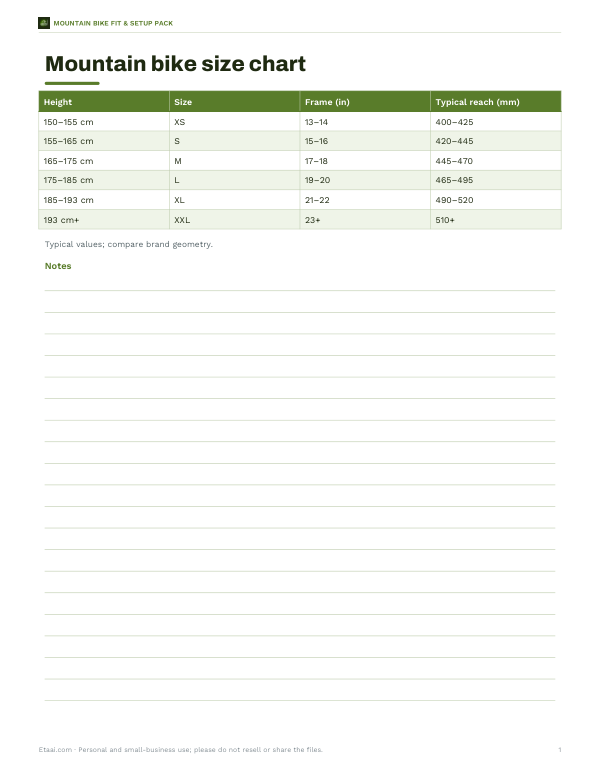
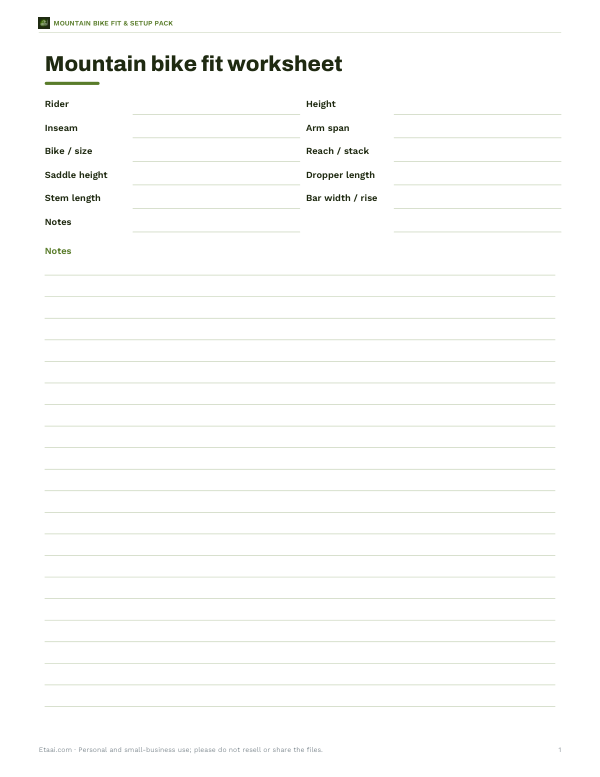
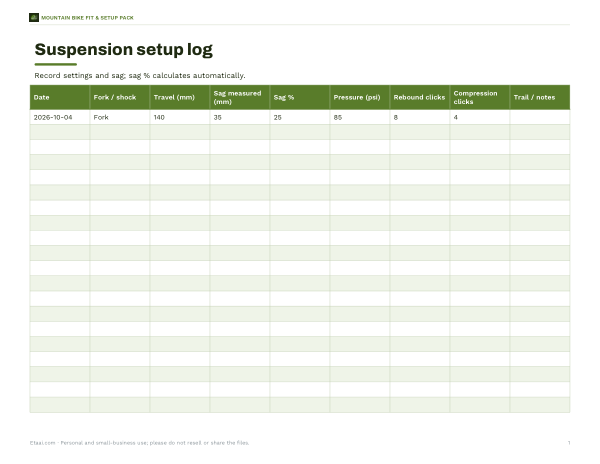
Printable MTB size chart with reach ranges, a bike fit measurement worksheet, a suspension setup log (Excel) and a trail ride pre-check list.
- Size chart (PDF)
- Fit worksheet (DOCX/PDF)
- Suspension log (XLSX)
- Pre-ride check (PDF, DOCX)
Formats: PDF, XLSX, DOCX. Instant download after payment (link valid 72 hours, up to 5 downloads). AI-assisted: the templates were drafted with AI help and reviewed and laid out before publishing.
$5.00 USD, one-time 4 files · about $1.25 each
- Instant download
- 7-day refund
- Secure checkout by Stripe
7-day money-back guarantee. Full refund within 7 days of purchase, even after you download.
Free sample: MTB Fit Worksheet (PDF, 60 KB)
Full refund within 7 days — see the refund policy and license.
Free printables
Single sheets you can print right now, no sign-up. The full pack adds every sheet in one download plus the editable files.
 Printable Pre-Ride Check
Mountain bike size chart
| Rider height | Size | Frame (in, traditional) | Typical reach (mm) |
|---|---|---|---|
| 4′11″–5′1″ (150–155 cm) | XS | 13–14 | 400–425 |
| 5′1″–5′5″ (155–165 cm) | S | 15–16 | 420–445 |
| 5′5″–5′9″ (165–175 cm) | M | 17–18 | 445–470 |
| 5′9″–6′1″ (175–185 cm) | L | 19–20 | 465–495 |
| 6′1″–6′4″ (185–193 cm) | XL | 21–22 | 490–520 |
| 6′4″+ (193 cm+) | XXL | 23+ | 510+ |
Reach values are typical of modern trail bikes and vary widely between brands and models. Use them to compare, not as a rule.
Why reach matters more than frame size
Older mountain bikes were sized by seat tube length in inches. Modern bikes have shorter seat tubes, dropper posts and longer, slacker front ends, so two “medium” bikes can feel very different. Reach — the horizontal distance from the bottom bracket to the top of the head tube — describes how stretched out you are when standing on the pedals, which is how you ride most technical terrain. Longer reach adds stability at speed; shorter reach feels more playful and easier to manoeuvre.
Standover and seat tube length
Standover height is the height of the top tube where you stand over the bike; you need some clearance for safe dismounts — a few centimetres at least. Seat tube length also matters with dropper posts: a short seat tube lets you run a longer-travel dropper and get the saddle out of the way on descents. Check that your saddle height (roughly inseam × 0.883, measured from the bottom bracket) fits within the frame’s seat post insertion and dropper length.
Choosing between two sizes
| If you… | Consider |
|---|---|
| Prefer a lively, playful ride | The smaller size |
| Ride fast, steep terrain | The larger size for stability |
| Have long arms and torso for your height | The larger size |
| Have long legs and shorter torso | The smaller size |
| Ride cross-country and long climbs | Often the larger size for a stretched, efficient position |
| Want to fit a long dropper post | The size with the shorter seat tube |
Wheel size and frame size
Most adult mountain bikes use 29-inch wheels, 27.5-inch wheels, or a mix (“mullet”: 29 front, 27.5 rear). Smaller frames sometimes come with 27.5-inch wheels to improve fit for shorter riders. Wheel size affects handling — 29ers roll over obstacles more easily, 27.5 wheels feel more nimble — but does not change your frame size.
How to measure height and inseam
- Measure height barefoot against a wall.
- For inseam, stand barefoot with feet slightly apart and pull a hardback book up firmly between your legs.
- Mark the top of the book on the wall and measure to the floor.
- Take the average of two or three measurements.
Worked example
A rider 178 cm tall with an 82 cm inseam rides trails. The calculator suggests size L (19–20 inch traditional frame) with a typical trail-bike reach of 465–495 mm, noting that at 178 cm they are close to the M/L boundary. For a playful bike park setup they might choose M; for fast, rough descents, L. They compare the reach numbers of two models they like and book test rides on both sizes.
Fine-tuning fit
- Stem length: shorter stems (35–50 mm) sharpen steering on modern trail bikes.
- Handlebar width and rise: wider bars add control; riser bars raise the front.
- Saddle position: adjust fore-aft for pedalling comfort, not reach.
- Dropper post length: as long as fits your inseam and frame.
- Suspension setup: set sag correctly for your weight — it changes how the bike fits when riding.
E-MTB and women’s sizing
Electric mountain bikes follow the same sizing principles, but their extra weight and longer chainstays can make them feel more stable, so many riders choose the size they would ride on a regular trail bike. Women’s-specific mountain bikes are now less common; most brands offer unisex frames in a wide size range with different contact points (saddles, grips, bar width). Compare reach and stack rather than labels.
Kids’ mountain bikes
Children’s mountain bikes are sized by wheel size — 20, 24 and 26 inches — with inseam guidance from the maker. A child should be able to stand over the bike with both feet flat and reach the brake levers comfortably. Avoid buying a bike far too big to “grow into”; it is harder to control and less safe.
Privacy
The calculator runs in your browser; your measurements are not stored.
Frequently asked questions
What size mountain bike for 5′10″?
Usually medium or large, depending on inseam, reach and riding style.
What size MTB for 6 ft?
Typically large.
What does an 18-inch mountain bike mean?
An older sizing method based on seat tube length — roughly a medium.
Should I size up or down on a mountain bike?
Up for stability and long reach, down for agility — test ride both if you can.
Is MTB sizing the same as road bike sizing?
No. Mountain bikes use S–XL and reach; road bikes use centimetres and a different geometry.
Does wheel size change my frame size?
No, but small frames sometimes use 27.5-inch wheels for better fit.
How much standover clearance do I need?
A few centimetres at least, so you can straddle the bike comfortably when you stop.
What size is a medium mountain bike?
Typically for riders about 165–175 cm, with 17–18 inch traditional frame sizes.
Is my data stored?
No, it runs in your browser.